
REVIEW · TIRANA CITY TOURS & EXPERIENCES
Tirana Walking Tour: History, Culture &Gems by a Passionate Guide
Tirana makes more sense by foot. This 3 to 4 hour English walking tour strings together Tirana’s biggest landmarks, from Skanderbeg Square to Blloku, so you leave with a clear mental map and real context. It runs with a maximum group size of 11 and ends back where you start.
I like how the pacing stays relaxed but still story-rich, so you get the why behind what you see, not just names and dates. I also love the included rakia tasting, because it makes the whole experience feel local, not just sightseeing.
One thing to consider: it’s a walking tour and most stops are outside, so comfy shoes and a weather-friendly day really matter. Also, the entry to the Museum of Secret Surveillance (Shtëpia me Gjethe) is not included, so budget a bit extra if you want to go in.
In This Review
- Key things to know before you go
- Getting Your Tirana Bearings Fast at Skanderbeg Square
- Skanderbeg Square to Sulejman Pasha Square, Two Ways to Read the City
- Et’hem Bej Mosque and the Clock Tower, Where Ottoman and Venetian Meet
- Pazari i Ri and Teqja Pazari, Local Life Plus Spiritual Tradition
- Kapllan Pasha’s Tomb and Toptani Sarajet, Old Tirana in Stone and Wood
- Bunk’Art 2 and the House of Leaves, When Tirana Shows Its Communist Layers
- Blloku and the Postbllok Checkpoint Memorial, From Power to Pop Culture
- Resurrection Cathedral, Catholic Quiet, and Tirana’s Strange Modern Icons
- Rakia Included and the Real Reason This Tour Feels Personal
- Price and Value: Is $36.20 Worth It?
- Practical Tips So You Enjoy Every Stop Without Rushing
- Should You Book This Tirana Walking Tour?
- FAQ
- How long is the Tirana Walking Tour?
- What is the price per person?
- Is the tour in English, and how many people are in a group?
- What is included in the tour?
- Are tickets included for every stop?
- What if I need to cancel or the weather is bad?
Key things to know before you go
- Albiona’s storytelling style keeps history clear, with time for questions
- Rakia included for a proper Tirana touch
- Et’hem Bej Mosque frescoes show rare natural motifs inside a modest exterior
- Communist-era stops range from Bunk’Art 2 to Postbllok checkpoint memorial
- Religion and revival are part of the walk, including the Orthodox Resurrection Cathedral
- Maximum 11 people means you are not lost in a crowd
More of Tirana on foot, on two wheels and after dark
- Albanian Night Show: Traditional Music, Dance & Dinner in Tirana★ 5.0 · 431 reviews
- Cooking Classes and Traditional food tasting in Tirana★ 5.0 · 282 reviews
- Local food experience & walking tour of Tirana★ 5.0 · 192 reviews
- Tour a Piedi di Tirana★ 5.0 · 174 reviews
- Best of Local Food & City Tour of Tirana – Food & Drinks Included★ 5.0 · 160 reviews
Getting Your Tirana Bearings Fast at Skanderbeg Square
If your first instinct in a new city is, Okay, where am I?, this tour fits that moment. You begin at Skanderbeg Square (Plaza Tirana, Sheshi Skender Beu, Tirana 1001) and you stay in the core of downtown where the streets, monuments, and neighborhoods all connect.
Skanderbeg Square is more than a photo spot. It is the main public square, named for Albania’s national hero, Skanderbeg, and it sets the tone for the whole walk. From here, you can feel how Tirana mixes Ottoman-era legacies, Venetian-era touches, and later 20th-century political history into one compact geography.
I also like that the pace works for an arrival day. This is long enough to make sense of the city, but short enough that you can still wander afterward without feeling like you got hit by a bus tour.
Skanderbeg Square to Sulejman Pasha Square, Two Ways to Read the City
After starting at Skanderbeg Square, you also stop at Sheshi Sulejman Pasha (Sulejman Bargjini Square). It is smaller than Skanderbeg, but it still matters because it honors Sulejman Bargjini, the founder of Tirana. That little shift helps you understand something important about cities like Tirana: the story is not only in big buildings, it is also in the names of the streets and squares.
A tip that will help you on the walk: when you arrive in Tirana, look for how people move through the space. Even on a short stop, Skanderbeg Square and Sulejman Pasha Square show you how locals use the center for everyday life, not just ceremonies and monuments.
If you want to plan the rest of your day, this is a good starting point because these squares act like orientation hubs. You can decide later where to go next based on what you felt most curious about.
Et’hem Bej Mosque and the Clock Tower, Where Ottoman and Venetian Meet
The walk into Et’hem Bej Mosque is one of those moments where the exterior does not prepare you for what is inside. From the outside, it is modest. Then inside, you get frescoes with intricate floral and natural motifs, including depictions that feel almost like a landscape painting, with trees, waterfalls, and bridges. That mix is rare enough in Islamic art to make it memorable.
The time at the mosque is short, but it is well used. You are there long enough to look, notice the style, and understand why the decoration matters, without turning it into a lecture you regret.
From there, you head to the Clock Tower, a recognizable Tirana landmark. It rises about 35 meters, built in the 19th century, and you can see a combination of Ottoman and Venetian architectural influences. In other cities, clock towers are just vertical markers. Here, it is a clue to Tirana’s layered influences.
If you care about architecture, do yourself a favor: stand back for a minute when you reach the tower. Then look again from a different angle. The styles make more sense when you see the tower as a landmark within a street grid, not only as a single object.
Pazari i Ri and Teqja Pazari, Local Life Plus Spiritual Tradition
Next up is the New Bazaar, Pazari i Ri. This is the part of the walk that feeds your senses. You will see stalls and shops with fresh produce, local crafts, spices, and traditional Albanian foods. Even if you do not buy anything, this stop helps you understand Tirana as a place where commerce and daily routine happen right next to major landmarks.
I also like that the tour does not pretend you are here for shopping only. It uses the market stop as cultural context: how food, spices, and everyday goods connect to identity.
Then you visit Teqja Pazari, a Bektashi religious site. The teqe, basically a Bektashi monastery, is part of the Bektashi Order, a Sufi Muslim sect associated here with mysticism and progressive values. That matters in Tirana because Albania is not one-note religiously. This stop gives you a different lens than the bigger state monuments do.
Practical note: the time at each stop is brief, so your job is simple. Look closely, ask questions if you want more detail, and let the stop be a snapshot rather than a full museum visit.
More of Albania taken at walking pace

Kapllan Pasha’s Tomb and Toptani Sarajet, Old Tirana in Stone and Wood
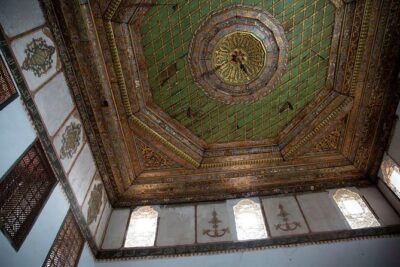
You stop at Kapllan Pasha’s Tomb, also referred to as the Tomb of Kapllan Pasha. This is recognized as a Cultural Monument of the first category, declared by Albania’s government in 1948. It is from the early 19th century and features carved stonework and an octagonal shape. The columns are stone, sitting on stone bases and capitals decorated with plant motifs.
What makes this tomb more than a shape in a park is the story tied to it: the former ruler of Tirana was interned there in the 19th century, then later repatriated back to Istanbul, Turkey. That single detail helps you connect Tirana to wider regional history.
Right after, you also visit the Ethnographic Museum of Tirana, known as the Toptani Sarajet Old Typical House. This gives you a more human scale view of life in Albania. Instead of big political buildings, you see a preserved example of traditional Albanian living.
If you are short on time in Tirana, this pairing works. The tomb gives you political and memorial history. The typical house gives you daily-life texture.
Bunk’Art 2 and the House of Leaves, When Tirana Shows Its Communist Layers
One of the tour’s strongest pulls is how it handles Albania’s communist past without turning it into doom-and-gloom only. You visit Bunk’Art 2, described as an immersive historical site inside a former bunker used during Albania’s communist era. Even though your time at each stop is limited, the setting itself does the work. You are literally in the kind of structure people feared and depended on.
Then you reach the Museum of Secret Surveillance, the House of Leaves (Shtëpia me Gjethe). This one is different: it is included as a stop, but the admission ticket is not included, so you will need to decide on-site if you want to pay to go in.
The tour data frames it as a site tied to the unique history of communist-era secret surveillance. That means your visit here is likely to focus on how the system worked and why people lived with uncertainty. It is a heavier stop, but it is also part of understanding why Tirana’s modern identity comes with so much memory built into the streets.
If you feel overwhelmed by political history, do not force it. This is exactly the kind of tour where you can ask your guide what to prioritize based on your tolerance and interests.
Blloku and the Postbllok Checkpoint Memorial, From Power to Pop Culture
You then move into Postbllok, the Checkpoint Memorial. This is an open-air installation that acts as a reminder of Albania’s communist past, located near the entrance of the Blloku neighborhood. It symbolically points at the oppressive regime and the reality that many lives were shaped by control.
After that comes Shtepia Partise Enver Hoxha, the former villa of Enver Hoxha. It is a key part of Albania’s communist history, and it sits in Blloku. This villa was the private residence of the long-time dictator, and the neighborhood was once off-limits to ordinary citizens. You are seeing a place built for power and secrecy, not public life.
Then you walk through Blloku itself. Today it is one of Tirana’s most lively areas, mixing modern life with the weight of what used to be an exclusive zone for the communist elite. That contrast is the whole point. You are watching a city change, without pretending the past disappeared.
Two extra street-level stops support the feeling of place: Shallvaret (a neighborhood with deep roots in the city’s past and present) and Rruga Murat Toptani, a street known for blending historical charm with modern appeal.
This section is also where small-group format matters. With fewer people, you can stop longer when a detail catches your attention, or ask how the story connects to what you see later while exploring on your own.
Resurrection Cathedral, Catholic Quiet, and Tirana’s Strange Modern Icons
After the communist sites, the tour shifts tone toward religion and rebuilding, then into modern symbols.
You visit the Orthodox Cathedral of Resurrection. This is a big deal because it represents Albania’s return to religious freedom after decades of suppression. The cathedral was constructed between 2001 and 2012 and consecrated on June 24, 2012. The tour description also explains that under Enver Hoxha, Albania declared itself the world’s first atheist state in 1967, with religious practices banned, and many churches, mosques, and religious sites destroyed or repurposed.
That explanation is not just trivia. It helps you understand why a cathedral can feel like a political event in its own right. It is not only about faith. It is about what a society is allowed to be.
You also stop at Saint Paul’s Cathedral, a Catholic cathedral in Tirana, framed as a blend of architectural beauty, spiritual tranquility, and cultural insight. Since your time here is short, treat it as a reset moment, not a full religious service experience.
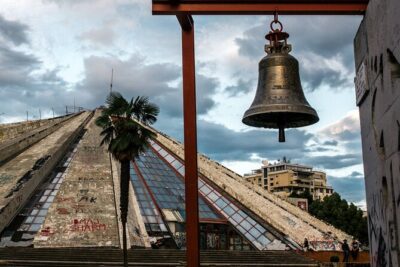
Then comes a few “Tirana in one glance” stops. Bank of Albania is the central bank, established in 1925, one of Albania’s older financial institutions. Then you see the Pyramid of Tirana, noted for its unique history and contemporary transformation. Finally, you visit Tirana Castle, where ancient ruins and modern attractions share the same space.
These stops help you understand that Tirana is not just history. It is history under renovation, still being used and repurposed as the city moves forward.
Rakia Included and the Real Reason This Tour Feels Personal
Let’s talk about what you get for the price beyond the list of stops.
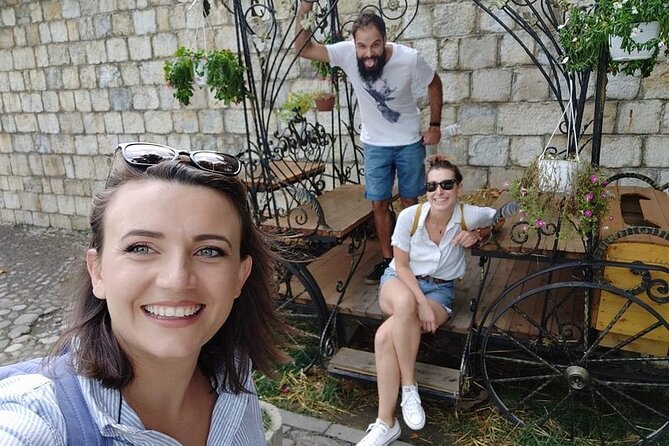
The tour includes a complimentary shot of rakia, a traditional Albanian spirit. This is not a gimmick if the guide uses it as part of the cultural conversation. It also gives you a natural break in the middle of a walking schedule, which makes the whole tour easier to enjoy.
The other big factor is the guide, Albiona. Multiple reviews highlight her strong English and her ability to connect history to what Albania is doing today. People also praised her flexibility when time gets messy. One example mentioned a long delay in traffic arriving in the center of Tirana, and the guide still found a way to keep the experience enjoyable and efficient.
That flexibility matters more than most people realize. When you are walking around cities with limited patience for traffic or tight schedules, a guide who can adjust keeps your day from feeling ruined.
Price and Value: Is $36.20 Worth It?
At $36.20 per person for a 3 to 4 hour small-group tour, this is priced like a smart entry ticket to city understanding, not like a full-day program.
Here is why it can feel good value:
- Small group (max 11), which often means more back-and-forth and less crowd pressure
- English-speaking guide and a route packed with major anchors of Tirana
- Mobile ticket, so you can keep things simple
- Most stops list free admission, including major landmarks like Skanderbeg Square, Et’hem Bej Mosque, the Clock Tower area, and others
- Rakia tasting included, which adds a local touch you cannot buy at every stop
The one cost you should plan for is that the Museum of Secret Surveillance ticket is not included. If you care about that subject enough to go in, treat it as the main optional extra in the budget.
Also, this tour is booked about 33 days in advance on average. That does not mean you need to panic. But it does suggest demand is steady, so if you are visiting during a peak period, you will likely enjoy life more by booking sooner.
Practical Tips So You Enjoy Every Stop Without Rushing
Bring comfortable walking shoes. This is a downtown circuit with short visits at lots of places, so your feet do the heavy lifting.
Check the weather. The experience requires good weather, and if it is canceled due to poor weather, you should expect a different date or a full refund.
Wear layers if it swings between cool mornings and warmer afternoons. And keep a small amount of cash or card ready, just in case you decide to pay for the House of Leaves entry at the Museum of Secret Surveillance, since that part is not included.
One more simple strategy: pick 2 themes before you start. For example, communist history and religion, or Ottoman architecture and neighborhoods. Then ask Albiona questions as you go. The tour is set up so you can steer your learning toward what you care about.
Should You Book This Tirana Walking Tour?
Book it if:
- You want an easy way to get oriented fast in Tirana
- You like history that connects directly to what you can see in the streets
- You prefer a small group experience with time for questions
- You want a guide who can explain both the hard parts and the resilience of Albanian culture
Skip or adjust your plan if:
- You hate walking and would rather spend your time inside one museum only
- You do not want any focus on communist-era sites
- You are mainly in Tirana for one niche interest, like only architecture or only food, and you would rather go deep in one place
If you do book, I recommend doing it early in your visit. Starting with Skanderbeg Square and moving outward gives you a mental map that makes the rest of your days in Tirana feel less random.
FAQ
How long is the Tirana Walking Tour?
The tour runs about 3 to 4 hours.
What is the price per person?
The price is $36.20 per person.
Is the tour in English, and how many people are in a group?
The tour is offered in English, and it has a maximum group size of 11 travelers.
What is included in the tour?
You get a complimentary shot of rakia as part of the experience, and the tour provides a mobile ticket.
Are tickets included for every stop?
Most stops are listed as admission free, but the Museum of Secret Surveillance (House of Leaves, Shtëpia me Gjethe) is specifically noted as not included.
What if I need to cancel or the weather is bad?
You can cancel up to 24 hours in advance for a full refund. The tour requires good weather, and if it is canceled due to poor weather, you will be offered a different date or a full refund.
More Albanian Tours, Rated
Still in Tirana? Keep Going

Every Albania Review We Have
Latest Albania reviews off the desk
- UNESCO heritage in Albania – 4 days
★ 5.0 · 3 reviews - Transfers Tirana Airport – Sarande – Ksamil – Airport Tirana
★ 4.5 · 3 reviews - Private Transfers from Tirana International Airport to Sarandë
★ 4.5 · 3 reviews - Tirana’s Communist Past: A Tasting Tour with Traditional Lunch
★ 5.0 · 3 reviews - Tirana ⇔ Ohrid, North Macedonia
★ 5.0 · 3 reviews - Tirana and Kruja in a Day Trip
★ 5.0 · 3 reviews
Tirana City Tours & Experiences, compared.
 ★ 5.0Walking Tour of TiranaFrom $18646 reviews
 ★ 5.0Albanian Night Show: Traditional Music, Dance & Dinner in TiranaFrom $53431 reviews
 ★ 5.0Cooking Classes and Traditional food tasting in TiranaFrom $49282 reviews
 ★ 5.0Local food experience & walking tour of TiranaFrom $60192 reviews
 ★ 5.0Tour a Piedi di TiranaFrom $20174 reviews
 ★ 5.0Best of Local Food & City Tour of Tirana – Food & Drinks IncludedFrom $72160 reviews
 ★ 5.0Traditional Albanian Cooking Class in Tirana with Raki TastingFrom $53125 reviews
 ★ 5.0Bike or E-Bike Tour Tirana: Highlights & Grand Park Guided CycleFrom $42124 reviews
Browse the lists this tour appears in