
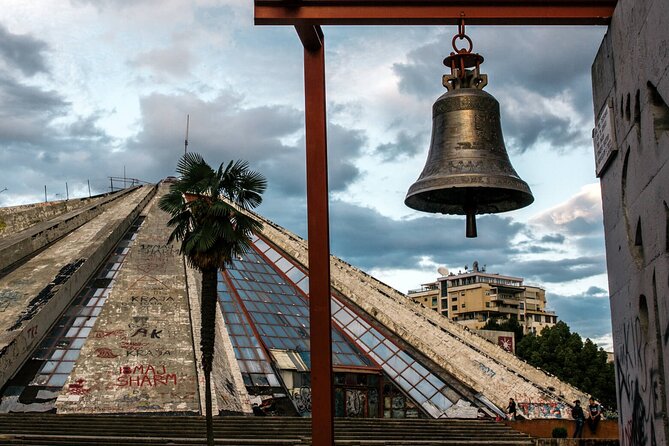
REVIEW · TIRANA CITY TOURS & EXPERIENCES
Tour a Piedi di Tirana
Tirana tells its story on foot. Tour a Piedi di Tirana is a tight 2 hours 30 minutes walking loop that turns famous landmarks into a clear, human overview of how the city works, from religious monuments to communist-era memory. You start in the center, walk at an easy pace, and end back where you began, which is great for first-time orientation.
I love how the tour is guided by a licensed English and Italian speaker, with explanations that make the stops easier to place. I also love the mix of big symbols and specific local details, like Skanderbeg Square, Tanners’ Bridge, and the Enver Hoxha story told through multiple sites. On one recent outing, the guide Martin and later Ilir stood out for making the whole route feel like conversation, not a lecture.
One possible drawback: it is a fast-moving highlights circuit, with many stops and short explanations. If you want long museum time or slow photo stops, you will probably wish you had a longer second visit to your favorite site.
In This Review
- Key things to know before you go
- Meeting at Et’hem Bej Mosque and how the 2.5-hour loop works
- Skanderbeg Square, monuments, and the city’s big picture
- Et’hem Bej Mosque and Namazgah Mosque, faith you can actually see
- BunkArt 2 and why two museums get discussed in one stop
- Fortress of Justinian ruins, a reality check on the older layers
- Parliament of Albania, politics explained without the jargon
- Tanners’ Bridge, a small stop with big street-level meaning
- Saint Paul Cathedral and Orthodox Autocephalous Church, religion in different forms
- Enver Hoxha’s Pyramid, Postbllok, and the Bllok area explained in one storyline
- Enver Hoxha’s former residence, Taiwan Pool, Orthodox church stop again, and House of Leaves
- Price and value: $20.93 for a guided Tirana circuit
- Who should book this walking tour (and who might feel rushed)
- Should you book Tour a Piedi di Tirana?
- FAQ
- Where does the tour start and end?
- How long is Tour a Piedi di Tirana?
- What languages are the guides?
- Is admission included for the stops?
- How big are the groups?
- Do I need a printed ticket?
- What weather conditions are required?
- Are service animals allowed?
- What is the cancellation window for a full refund?
Key things to know before you go
- Start and finish in the same place: Et’hem Bej Mosque on Sheshi Skënderbej 1, then back again
- Licensed English and Italian guide: included, with an interactive style
- A packed route in 2 hours 30 minutes: around 10 minutes per stop, plus a wrap-up at Skanderbeg Square
- Communist-era stops in one sweep: Enver Hoxha Pyramid, Postbllok checkpoint monument, Bllok area, and House of Leaves
- Small group feel: maximum 25 travelers, mobile ticket, near public transport
More of Tirana on foot, on two wheels and after dark
- Albanian Night Show: Traditional Music, Dance & Dinner in Tirana★ 5.0 · 431 reviews
- Cooking Classes and Traditional food tasting in Tirana★ 5.0 · 282 reviews
- Local food experience & walking tour of Tirana★ 5.0 · 192 reviews
- Tour a Piedi di Tirana★ 5.0 · 174 reviews
- Best of Local Food & City Tour of Tirana – Food & Drinks Included★ 5.0 · 160 reviews
Meeting at Et’hem Bej Mosque and how the 2.5-hour loop works
This tour is built for practical city touring. It starts at Et’hem Bej Mosque (Sheshi Skënderbej 1, Tirana 1001, Albania). You walk a loop through the central sights and end back at the same meeting point, so you are never stuck wondering how to get home or where the tour disappears to.
The route is designed around quick interpretation. Expect short stops, with the guide explaining what you are seeing and why it matters, then moving you along. That is one reason the overall timing is about 2 hours 30 minutes. It is long enough to feel like you did something real, but short enough to fit into an arrival day or a half-day planning block.
The guide is licensed and speaks English and Italian. In practice, that usually means you can ask questions and get answers that connect the places to each other. One reason people rave about this tour is that guides like Martin are described as entertaining and able to adapt when the group needs the story repeated in another language.
One more detail that helps: you carry a mobile ticket. That reduces friction once you are in Tirana. And because it is near public transportation, you can stitch this tour into your own schedule without needing private transport.
Skanderbeg Square, monuments, and the city’s big picture
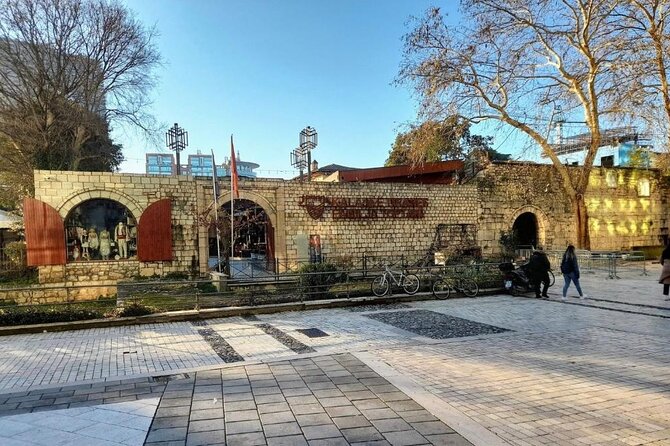
Skanderbeg Square is where the tour begins and where it ends. That is not a coincidence. It is the kind of central reference point that makes it easier to navigate the rest of your stay. Even if you only remember one thing, the square becomes your anchor for the day.
At the start, your guide uses it as a starting map. You learn how Tirana tries to present its identity, and how those public symbols connect to the country’s shifting politics. Then, near the end, you return for a final look, so the earlier explanations land better. It is like getting the captions first, then re-reading the city from a different angle.
What to watch for here is not one statue. It is the overall layout. Squares in capitals are often about power and pace, and Skënderbeg Square gives you a sense of both. You also get an easy way to judge weather and light for the rest of your photos before you head into the more specific stops.
Et’hem Bej Mosque and Namazgah Mosque, faith you can actually see
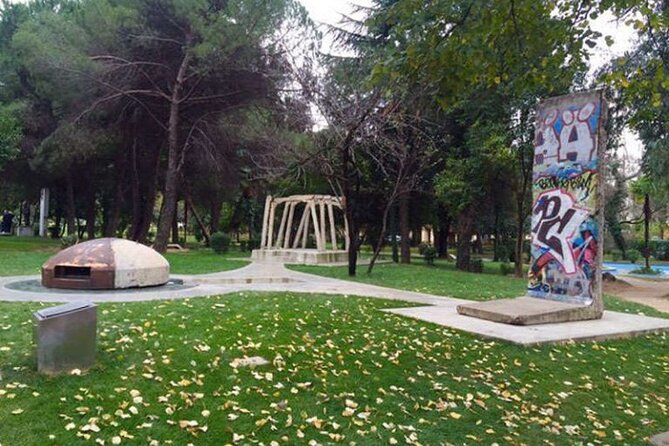
You start the walking route at Et’hem Bej Mosque, then later you also visit the Mosque of Namazgah. Having two mosques in one tour is useful because it lets you compare how religious space fits into Tirana’s day-to-day streets.
At Et’hem Bej Mosque, the explanation helps you understand what you are looking at beyond the obvious. You are not just standing in front of a famous building. You learn how it connects to the city’s historical rhythms and community life.
Namazgah Mosque is a different stop in scale and presence. The tour description frames it as the biggest Mosque in Balkan. Even if you have not memorized the Balkans map, you will feel the difference when you see the setting and hear the guide’s framing of its importance. This is one of those stops where your brain starts sorting the city into “what it was” and “what it became.”
Because both mosque visits are short (about 10 minutes each), treat them as orientation stops. If you want deeper time inside, plan a second trip on your own. But for getting the gist fast, this works.
BunkArt 2 and why two museums get discussed in one stop
Bunk’Art 2 is a major clue to how Albania remembers the 20th century. In this tour, the guide explains BunkArt 1 and BunkArt 2 as part of the same stop sequence. That matters because it prepares you for later sites tied to the same era.
Even with only about 10 minutes here, you can pick up a lot if you listen for themes the guide connects. You are essentially learning how museums can function like time machines. Instead of only seeing artifacts, you understand the narrative choices behind what is shown, what is emphasized, and how the city wants you to interpret that period.
The practical benefit is that this stop makes the next ones easier. When you go toward Enver Hoxha-related sites after this, you will already have context for why the tour includes multiple layers of communist-era memory rather than just one quick monument.
Admission is listed as free for this stop, which helps value. It means you can spend your money on your time in Tirana, not only on tickets.
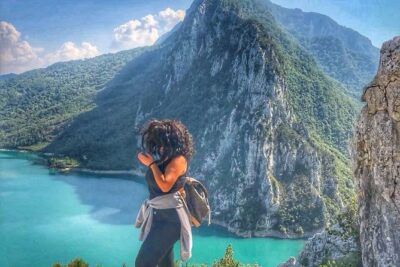
Fortress of Justinian ruins, a reality check on the older layers
The Fortress of Justinian stop is brief, but it is a useful correction to the idea that Tirana is only modern. You hear explanations tied to the ruins of the Tirana castle. This is where the city stretches backward, and your mental map starts adding new eras.
Ruins are tricky for visitors. Without context, they can look like random walls. With context, they become evidence. You start thinking like a historian for a minute, asking what these remnants suggest about defense, settlement patterns, and how places evolve from strategic locations into everyday neighborhoods.
The drawback is simple: with limited time, you may not get the emotional punch of a longer visit. Still, as part of a walking orientation tour, it is a smart inclusion. It keeps the tour from becoming only a “new Tirana” showcase.
Parliament of Albania, politics explained without the jargon
Next comes the Parliament of Albania. The stop description includes an explanation of the political situation in Albania. That does not mean you get a country seminar. It means the guide gives you enough framing so the monuments and modern institutions start to make sense.
This is where you learn to read buildings as signals. In many capitals, the government center is not just where decisions happen. It also communicates values, authority, and stability. Even if your politics knowledge is basic, you will walk away with a clearer understanding of what the city is trying to project today.
If you like your travel to connect streets to systems, this stop delivers. If you do not, it still functions as a quick orientation checkpoint before the route turns into more personal, memory-heavy sites.
Tanners’ Bridge, a small stop with big street-level meaning
Not all meaningful sights are gigantic. Tanners’ Bridge is exactly that kind of stop. The guide explains the bridge, and in practice, you end up looking at it as more than a photo moment.
Bridges represent movement, trade, and everyday connections. A bridge named for a trade also hints at the working side of the city, not only the ceremonial side. This is the kind of detail that helps you feel the city’s normal life, even when the tour is focused on major monuments.
Because the stop is short, you will get a quick narrative, then you keep walking. If you love street-level context, this is one of the stops you will mentally carry forward for the rest of your trip.
Saint Paul Cathedral and Orthodox Autocephalous Church, religion in different forms
The tour includes two Christian-era religious stops: Saint Paul Cathedral and the Orthodox Autocephalous Church of Albania. Seeing both matters because Albania’s religious identity is not a single story. You get two different expressions, explained in a way that connects them to the overall setting.
At Saint Paul Cathedral, the guide frames it as part of the religion in Albania. The value here is clarity. You learn what you are seeing and why it fits into the national mix, instead of treating churches as isolated landmarks.
Later, the Orthodox Autocephalous Church of Albania stop gives you another angle. This is your chance to compare how communities express belief through architecture and public presence. Even if you only spend about 10 minutes, the guide’s explanation helps you categorize what you see and remember it.
A small practical tip: for religious buildings, dress codes can vary by site and timing. The tour data does not spell out rules, so I suggest you bring a simple plan, light layer for shoulders or arms if needed, and keep it respectful.
Enver Hoxha’s Pyramid, Postbllok, and the Bllok area explained in one storyline
This is the section that most people connect with. The tour moves through multiple stops tied to Enver Hoxha, and it does it in a way that feels like a story arc rather than a random list of monuments.
First comes the Enver Hoxha Pyramid, described as the dictator pyramid. Next you visit Postbllok, the Checkpoint Monument. After that, the tour includes an explanation of the Bllok area. Together, these stops help you understand not only the person, but the social mechanism around the regime.
Postbllok is especially important because it turns history into a physical checkpoint idea. You get an explanation of the checkpoint memorial, and you start to see how the regime controlled access and movement. That sets up why the Bllok area matters as a concept. You are being told where the power lived and how that shaped everyday life.
The tour format helps here because you are not relying on one statue to carry the entire narrative. Instead, you get multiple angles: a symbolic monument (the pyramid), a control marker (Postbllok), and a broader neighborhood identity (Bllok area). That is how the tour makes the communist era feel less abstract.
Admission is listed as free for these stops, which is great value. And the guide’s storytelling is clearly a highlight, with Martin and Ilir both mentioned as strong performers.
Enver Hoxha’s former residence, Taiwan Pool, Orthodox church stop again, and House of Leaves
After Postbllok and Bllok area, the tour keeps tightening the focus. You visit Enver Hoxha’s Former Residence, then move toward Taiwan Pool (Pishina Taiwan), then later cover House of Leaves.
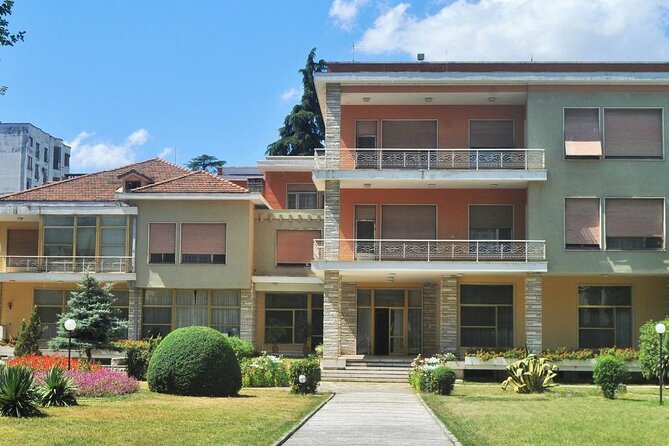
Enver Hoxha’s former residence is a key link between ideology and personal power. Standing near the idea of a home you are meant to imagine as ruling center territory gives your mind something to anchor to. The stop description is short, but the point is to connect the regime to physical spaces.
Then you get Taiwan Pool, also labeled as the Youth Park and Taiwan center in Tirana. This is a helpful contrast point after heavy political memory. It reminds you that the city is also about youth spaces, recreation, and how international relationships can show up as local facilities.
House of Leaves closes the loop on memory. The tour gives an explanation for the house of leaves, which signals that this site is tied to a specific interpretation of Albania’s past. Even in a short time window, you can usually understand the naming logic and the meaning the guide attaches to it.
At this stage, you are also back in a familiar zone. You have had enough central stops that the final return to Skanderbeg Square feels like a clean wrap-up. The tour ends where it started for a reason, it helps you leave with a mental map instead of scattered impressions.
Price and value: $20.93 for a guided Tirana circuit
The price is $20.93 per person for about 2 hours 30 minutes. That is not a long time, but it is a strong use of time if you are trying to get oriented fast and you want guidance at each stop.
Here is what makes the value math work:
- You get a licensed English and Italian speaking guide, not a self-guided route
- The experience is interactive, and the stops are structured with explanations
- Admission for the listed sights is shown as free in the tour plan
- Group size is capped at 25, so it usually stays more personal than the huge bus vibe
- You start at a central landmark and end there again, which reduces your logistical stress
What you should factor in: this tour does not include private transportation. That is fine, because it is a walking tour. Just be honest with yourself about your walking comfort and your energy on the day.
Also, this experience is weather dependent, and it requires good weather. If Tirana weather is rainy or stormy, you may be offered a different date or a refund. That is worth thinking about if you are scheduling around your flight times.
Who should book this walking tour (and who might feel rushed)
This works best if you want a guided orientation to Tirana that covers both the visible monuments and the underlying political memory. If you like seeing key sites grouped into a coherent storyline, this tour structure is built for you.
It also suits you if you only have one afternoon or your first day in the city. With a starting point at Et’hem Bej Mosque and an ending at Skanderbeg Square, you can keep exploring afterwards with less guesswork.
You might feel rushed if you prefer slow museum visits or if you like long, unhurried photo sessions. Because there are many stops, the tour is about breadth over depth. Pick one or two sites you want to revisit after, and let this tour act as your shortlist maker.
Should you book Tour a Piedi di Tirana?
Yes, I think you should book it if you want a fast, guided way to understand Tirana beyond just photos. The route is packed with key anchors, from Et’hem Bej Mosque and Namazgah Mosque to BunkArt 2, the Parliament area, and the Enver Hoxha cluster of sights including Postbllok and the Bllok area.
Two practical cautions keep it honest. First, it is short and fast, so bring comfortable walking shoes and accept that you are getting explanations, not full day museum depth. Second, there is one outlier complaint in the available feedback about the provider not showing up at the meeting point. You cannot erase that risk, but you can reduce it by arriving early to Sheshi Skënderbej, double-checking your start time, and having a plan for what you will do if nobody is there.
If you do that, this is a solid value walking tour that helps you get your bearings fast, then choose what to explore deeper on your own.
FAQ
Where does the tour start and end?
The tour starts at Et’hem Bej Mosque, Sheshi Skënderbej 1, Tiranë 1001, Albania. It ends back at the same meeting point.
How long is Tour a Piedi di Tirana?
The duration is approximately 2 hours 30 minutes.
What languages are the guides?
The experience includes an English and Italian speaking licensed guide.
Is admission included for the stops?
Admission is listed as free for the stops included in the tour.
How big are the groups?
This tour has a maximum of 25 travelers.
Do I need a printed ticket?
No. The tour uses a mobile ticket.
What weather conditions are required?
The tour requires good weather. If it is canceled due to poor weather, you will be offered a different date or a full refund.
Are service animals allowed?
Yes, service animals are allowed.
What is the cancellation window for a full refund?
You can cancel up to 24 hours in advance for a full refund. If you cancel less than 24 hours before the start time, the amount you paid will not be refunded.
More Albanian Tours, Rated
Still in Tirana? Keep Going

Every Albania Review We Have
Latest Albania reviews off the desk
- UNESCO heritage in Albania – 4 days
★ 5.0 · 3 reviews - Transfers Tirana Airport – Sarande – Ksamil – Airport Tirana
★ 4.5 · 3 reviews - Private Transfers from Tirana International Airport to Sarandë
★ 4.5 · 3 reviews - Tirana’s Communist Past: A Tasting Tour with Traditional Lunch
★ 5.0 · 3 reviews - Tirana ⇔ Ohrid, North Macedonia
★ 5.0 · 3 reviews - Tirana and Kruja in a Day Trip
★ 5.0 · 3 reviews
Tirana City Tours & Experiences, compared.
 ★ 5.0Walking Tour of TiranaFrom $18646 reviews
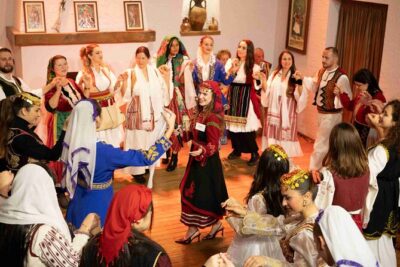 ★ 5.0Albanian Night Show: Traditional Music, Dance & Dinner in TiranaFrom $53431 reviews
 ★ 5.0Cooking Classes and Traditional food tasting in TiranaFrom $49282 reviews
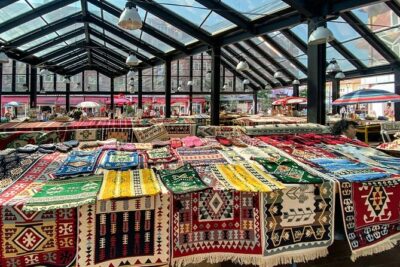 ★ 5.0Local food experience & walking tour of TiranaFrom $60192 reviews
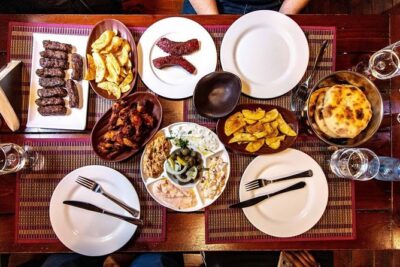 ★ 5.0Best of Local Food & City Tour of Tirana – Food & Drinks IncludedFrom $72160 reviews
 ★ 5.0Traditional Albanian Cooking Class in Tirana with Raki TastingFrom $53125 reviews
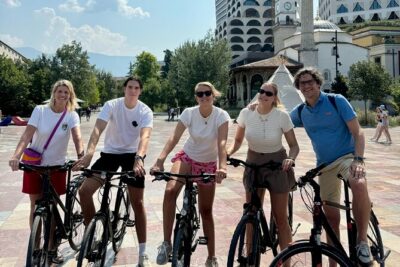 ★ 5.0Bike or E-Bike Tour Tirana: Highlights & Grand Park Guided CycleFrom $42124 reviews
 ★ 4.5Tirana Zipline Adventure in Petrelë – Albania’s First ZiplineFrom $3095 reviews
Browse the lists this tour appears in