
REVIEW · TIRANA CITY TOURS & EXPERIENCES
Inside Tirana Walking Tour
Tirana’s past and present share one sidewalk. This 2-hour walk connects the National Theatre of Opera and Ballet, Skanderbeg Square, the National History Museum, Postbllok, and Blloku, with English commentary led by guide Era. I especially like that the key stops are listed as free admission, so you’re paying for context, not entry fees.
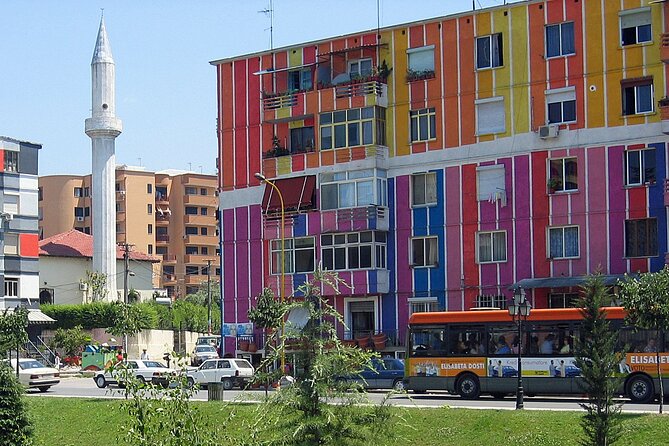
I also like how the route covers several sides of Tirana in a tight loop. You get state arts and national symbolism, then you hit the communist-era memory sites, and finish in Blloku, where the city’s social life shows up fast. On one visit, Era even added extra texture through street culture and murals, which makes the walk feel more lived-in.
One thing to keep in mind is the tour runs on foot and lasts about 2 hours, so your time inside any single place is limited. It also requires good weather, so plan for comfortable walking shoes and a light rain plan.
In This Review
- Key highlights worth knowing
- Where the walk begins at Et’hem Bej Mosque and Skënderbej Square
- National Theatre of Opera and Ballet, where Albania trains performers
- Skanderbeg Statue and the big-plaza city plan you can actually see
- National History Museum: a fast but focused tour through major eras
- Postbllok checkpoint monument, a somber lesson tied to real remnants
- Blloku district: from restricted communist neighborhood to Tirana’s social core
- Price and pace: what your $6.02 buys in real terms
- A few small logistics tips that make the walk smoother
- Should you book this Tirana walking tour with Zemra Travel?
- FAQ
- How long is the Inside Tirana Walking Tour?
- How much does the tour cost?
- Is the tour offered in English?
- Where does the tour start and end?
- What is included in the price?
- Are there admission fees for the stops?
- How many people are on the tour at most?
- What is the cancellation policy?
- Is the tour dependent on weather?
Key highlights worth knowing
- Free-admission route that turns your money into interpretation, not ticket cost
- Era-led English storytelling with an easy pace and clear city context
- Skanderbeg Square layout that lets you read Tirana’s Italian-era planning
- Postbllok checkpoint details that connect concrete remnants to Albania’s communist surveillance system
- Blloku district contrast from restricted communist neighborhood to today’s nightlife and café scene
More of Tirana on foot, on two wheels and after dark
- Albanian Night Show: Traditional Music, Dance & Dinner in Tirana★ 5.0 · 431 reviews
- Cooking Classes and Traditional food tasting in Tirana★ 5.0 · 282 reviews
- Local food experience & walking tour of Tirana★ 5.0 · 192 reviews
- Tour a Piedi di Tirana★ 5.0 · 174 reviews
- Best of Local Food & City Tour of Tirana – Food & Drinks Included★ 5.0 · 160 reviews
Where the walk begins at Et’hem Bej Mosque and Skënderbej Square
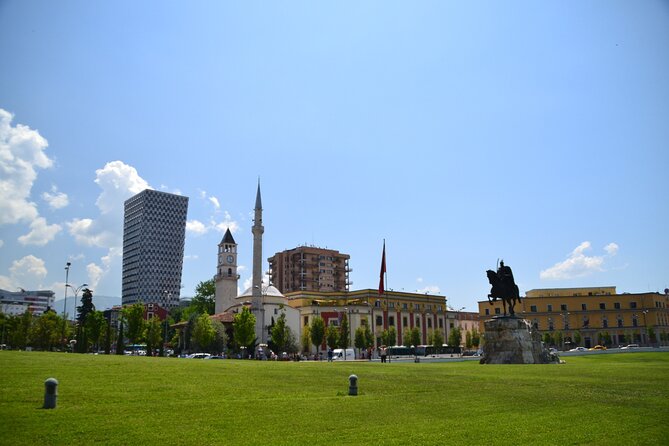
You’ll start at Et’hem Bej Mosque, right by Sheshi Skënderbej 1 in central Tirana. From the first moments, the area sets the tone: you’re stepping into the city’s main plaza zone, not a far-flung neighborhood with one landmark and a lot of transit time.
The ending point is the same as the meeting point, so you get an easy “loop back” plan. If you want to continue on your own after the tour, you’ll still be in the middle of things.
Also, the tour caps at 30 people, which usually keeps the group manageable on busy sidewalks. If you like asking questions, a smaller group setup helps.
National Theatre of Opera and Ballet, where Albania trains performers
The walk’s first major stop is the National Theatre of Opera and Ballet of Albania, housed in the building associated with the Palace of Culture since 1966. It’s not just a pretty façade. It’s tied to how Albania organized and nurtured high-level music and performance.
Here’s the useful context you’ll hear: the Albanian Philharmonic was established in 1950, bringing together the choir, symphony orchestra, opera singers, the ballet troupe, and the conductor. Over time, the country’s push for arts and culture supported the creation of the State Conservatory, described as the first vocational school and one of the largest musical institutions in the country.
When you stand in this spot, it helps to think of it as a cultural machine with a history. The theatre is presented as a national institution of its kind, compared in quality with the best theatres of the Balkans and beyond. That framing matters because Tirana is often seen through politics and change, but this is where you see a long-term commitment to the arts.
Practical tip: since the stop is about 15 minutes, come prepared to look first, then listen. If you want a deeper dive into programming or performances, plan a separate visit when events are on.
Skanderbeg Statue and the big-plaza city plan you can actually see
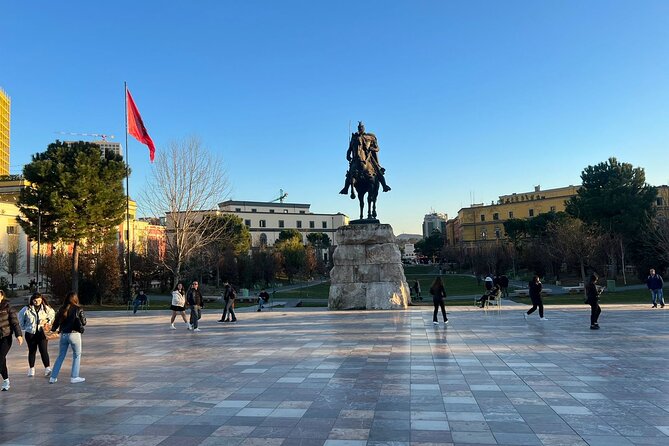
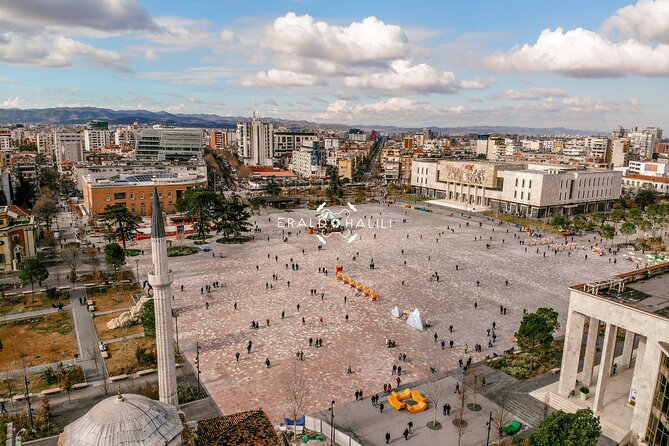
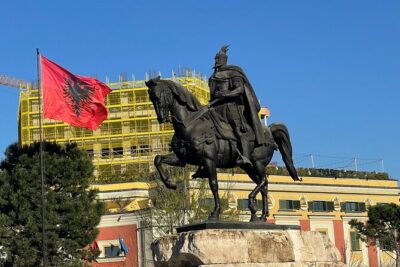
Next you’ll be at Skanderbeg Square, Tirana’s main plaza. The square covers around 40,000 square meters, and the Skanderbeg Monument is the visual anchor.
This is also one of the easiest places on foot to understand national symbolism in public space. The square is named for Gjergj Kastrioti Skënderbeu, a central Albanian national hero. Seeing the monument in person helps you grasp why so many civic events cluster around this kind of central landmark.
Then the tour shifts into urban design, which is a fun angle if you like architecture and how cities evolve. The original city plan for Tirana is described as starting with Armando Brasini in 1925, then continuing with Florestano Di Fausto in a Neo-Renaissance style with giant order fascias. After the Italian invasion, the master plan was updated in 1939 by Gherardo Bosio.
You’ll also learn that many major institutions sit around the square, including the Tirana International Hotel, Palace of Culture, National Opera, National Library, National Bank, Ethem Bey Mosque, the Clock Tower, City Hall, and multiple ministries, plus the National Historical Museum.
Even if you don’t memorize every building name, you’ll come away with something more useful: a mental map for what each landmark represents, and why this square feels like the center of government, culture, and identity.
Practical tip: bring your phone camera, but also look up. The scale around the square can make it hard to notice details if you’re only staring forward.
National History Museum: a fast but focused tour through major eras
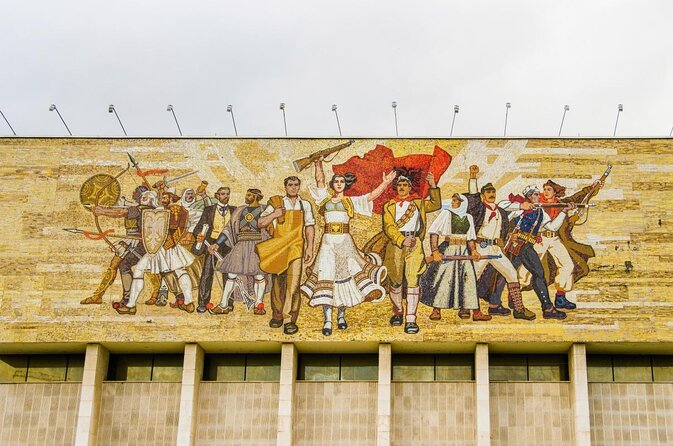
The walk then heads to the National History Museum, opened on 28 October 1981. The museum is large, around 27,000 square meters, with 18,000 square meters set aside for exhibitions.
Above the entrance, you’ll see a large mosaic titled The Albanians. The theme is described as depicting figures from ancient to modern times, which is a strong clue for how the museum wants you to read Albania’s story as continuous.
The stop is about 15 minutes, so you’re not doing a full self-guided marathon here. Still, the tour gives you a helpful framework by pointing to the museum’s main pavilions, which include:
- Pavilion of Antiquity
- Middle Ages
- Renaissance
- Independence
- Iconography
- National Liberation Antifascist War
- Communist Terror
- Mother Teresa
That list matters because it connects different chapters in one place. For example, Communist Terror prepares you for what you’ll face at Postbllok, while Mother Teresa gives you a modern anchor point after the heavier material.
If you tend to love museums, here’s the smart approach: use this stop as orientation. You’ll know what’s there and what might interest you, then you can return later with a short list of rooms you want to study longer.
More of Albania taken at walking pace

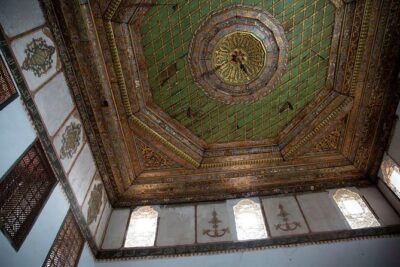
Postbllok checkpoint monument, a somber lesson tied to real remnants
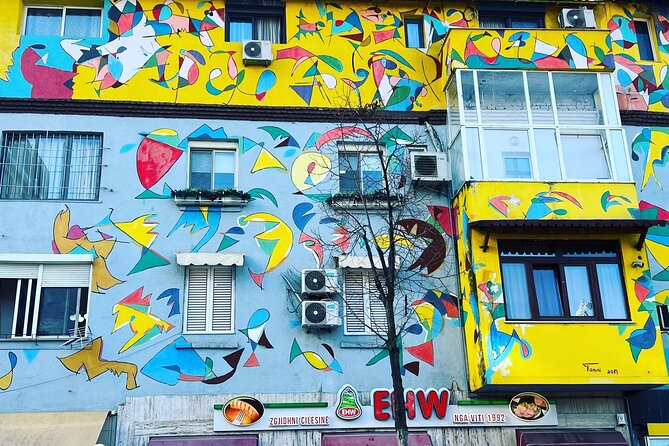
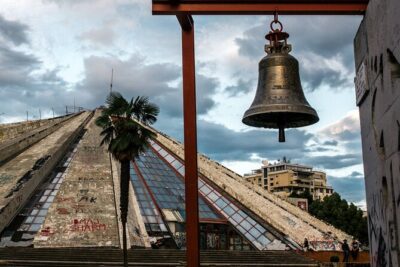
One of the most serious stops on the route is Postbllok, also called the Checkpoint Monument. This site is presented as a reminder of Albania’s communist past, especially surveillance and persecution under Enver Hoxha.
The physical details are what make it hit. The installation includes original concrete pillars from a notorious labor camp, an old bunker, and part of the Berlin Wall. That mix is heavy, but it helps you connect the story to something tangible rather than abstract talk.
This area is described as dedicated to the memory of those who suffered during the communist dictatorship, and it’s framed as a testament to Albanian resilience and the drive toward freedom and democracy.
Why this stop is valuable on a walking tour: it gives your history context a direct location in the city. When you only read about regimes, it stays theoretical. When you stand near remnants, the message becomes immediate.
Practical tip: take a moment to pause. The tour time at Postbllok is about 10 minutes, and it’s the kind of stop where a quick photo and move-on can feel disrespectful.
Blloku district: from restricted communist neighborhood to Tirana’s social core
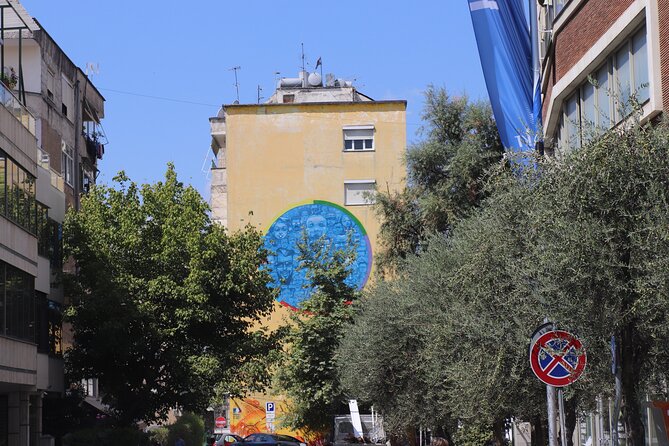
After the somber tone, the tour moves to Blloku, the upmarket area in Tirana known for entertainment. You’ll hear that it’s a hub for boutiques, restaurants, trendy bars, pubs, and cafés. It’s also part of the neighborhood called Tirana e Re, in southwestern Tirana.
This stop is about contrast. During the communist period, Blloku was a restricted residential zone reserved for members of the Albanian politburo, and ordinary Albanians were not allowed there. On many maps, it was even unmarked. The tour also notes that you can still find the residence of Albania’s communist leader Enver Hoxha here.
After the fall of communism, Blloku’s role changed dramatically. The area saw rapid new developments, including exclusive flats and apartments. It’s described as a playground for the young Albanian elite, and in peak summer months, trendy bars transfer along the Albanian Riviera, which shows you how Blloku connects Tirana to the seaside season.
If you’re trying to understand modern Tirana in one glance, this is where it shows. You see how a once restricted zone became a social magnet. Even if you don’t plan to go out that night, the district helps you picture where locals gather and what kind of city energy replaced the old rules.
Practical tip: if you want a longer look, stay near the edges of the Blloku area after the tour. You’ll be in a zone with plenty of options, and the tour ends right back near the central starting point.
Price and pace: what your $6.02 buys in real terms
At about $6.02 per person, this tour is priced like a budget-friendly orientation. The big value is what’s included: the guide, plus a mobile ticket and English commentary.
Just as important, the major stops are marked as free admission. That means you’re effectively paying for a structured route and explanations that stitch the city together. If you try to do these places alone, you might still see the sites, but you may miss the “why this matters” layer that the guide brings.
The tour runs for about 2 hours with multiple short stops of around 10 to 15 minutes each. That pacing is ideal if you’re in Tirana for a short time, or if you want a first pass through central highlights without committing to longer museum time.
Who this tour suits best:
- First-timers who want a city map in their head by the end
- History-minded walkers who also want a modern finish in Blloku
- People who prefer short, focused stops instead of all-day sightseeing
- Anyone who enjoys street culture as part of the story, not just monuments
Who might want a different plan:
- If you want deep time in the National History Museum, you’ll likely want to return separately. The stop is brief, so it’s more overview than full study.
- If you hate walking in the open, note that the experience requires good weather.
A few small logistics tips that make the walk smoother
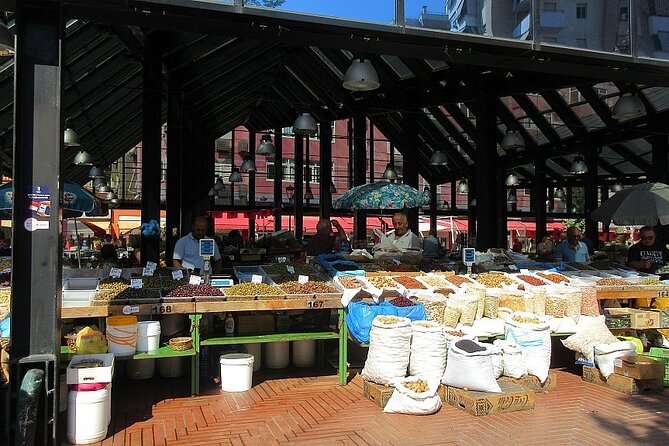
This tour is designed for most travelers and you’ll be near public transportation. Service animals are allowed, too, which is a helpful detail for anyone traveling with one.
Since the tour ends back where you start, it’s easy to layer it with the rest of your day. Do this early to set your bearings, then pick one or two places to revisit in more depth.
And yes, wear shoes you can trust. Tirana’s center is walkable, but you’ll be on your feet through multiple stops.
Should you book this Tirana walking tour with Zemra Travel?
I’d book it if you want a compact, high-signal introduction to Tirana. For the cost, you get a guided connection between Albanian culture, national identity, communist-era memory, and the modern social district of Blloku. The route also keeps the stops short, which helps you cover more ground without feeling stuck in one room for too long.
If you’re traveling as a pair, going solo, or with a small group, the cap at 30 travelers keeps things realistic for conversation and questions. If you’re especially drawn to any one theme, use the tour as a shortlist builder, then plan a follow-up visit on your own.
Where it might not fit: if you’re hoping for long, museum-style reading time, you’ll probably want a more self-paced day. Otherwise, this is a very practical way to understand Tirana in two hours.
FAQ
How long is the Inside Tirana Walking Tour?
It runs for about 2 hours.
How much does the tour cost?
The price is $6.02 per person.
Is the tour offered in English?
Yes, the tour is offered in English.
Where does the tour start and end?
It starts at Et’hem Bej Mosque on Sheshi Skënderbej 1, Tiranë 1001, Albania, and ends back at the same meeting point.
What is included in the price?
The tour includes the guide.
Are there admission fees for the stops?
The tour information lists admission as free at each of the stops.
How many people are on the tour at most?
The tour has a maximum of 30 travelers.
What is the cancellation policy?
You can cancel for a full refund up to 24 hours in advance. If canceled less than 24 hours before the start time, the amount paid is not refunded. If it’s canceled due to poor weather, you’ll be offered a different date or a full refund.
Is the tour dependent on weather?
Yes, the experience requires good weather.
More Albanian Tours, Rated
Still in Tirana? Keep Going

Every Albania Review We Have

Latest Albania reviews off the desk
- UNESCO heritage in Albania – 4 days
★ 5.0 · 3 reviews - Transfers Tirana Airport – Sarande – Ksamil – Airport Tirana
★ 4.5 · 3 reviews - Private Transfers from Tirana International Airport to Sarandë
★ 4.5 · 3 reviews - Tirana’s Communist Past: A Tasting Tour with Traditional Lunch
★ 5.0 · 3 reviews - Tirana ⇔ Ohrid, North Macedonia
★ 5.0 · 3 reviews - Tirana and Kruja in a Day Trip
★ 5.0 · 3 reviews
Tirana City Tours & Experiences, compared.
 ★ 5.0Walking Tour of TiranaFrom $18646 reviews
 ★ 5.0Albanian Night Show: Traditional Music, Dance & Dinner in TiranaFrom $53431 reviews
 ★ 5.0Cooking Classes and Traditional food tasting in TiranaFrom $49282 reviews
 ★ 5.0Local food experience & walking tour of TiranaFrom $60192 reviews
 ★ 5.0Tour a Piedi di TiranaFrom $20174 reviews
 ★ 5.0Best of Local Food & City Tour of Tirana – Food & Drinks IncludedFrom $72160 reviews
 ★ 5.0Traditional Albanian Cooking Class in Tirana with Raki TastingFrom $53125 reviews
 ★ 5.0Bike or E-Bike Tour Tirana: Highlights & Grand Park Guided CycleFrom $42124 reviews
Browse the lists this tour appears in