
REVIEW · TIRANA CITY TOURS & EXPERIENCES
Cultural Tour in Tirana including House of Leaves
Tirana tells its story in layers, and this tour reads fast. You start at Skanderbeg Square, then move through mosques, viewpoints, and art, all the way to communist-era sites like the House of Leaves. It is a tight, practical route that helps you connect what you see to what Albania lived through.
I especially liked two things. First, the guide explanations really make the big landmarks feel personal, and I’m glad I got to go with Gjuljana, who was both passionate and clear. Second, the balance works, from the darker history of the secret police to the lighter tone of Sali Shijaku’s paintings and the New Bazaar neighborhood.
One heads-up: it is a lot for 4 hours, and a couple of stops can be affected by site closures or by the fact that some areas are under change, like the Great Mosque construction. If you prefer slow sightseeing, you may want to pair this with extra time on your own after.
Skanderbeg Square is the perfect first landmark
- You get the statue, the neo-Renaissance buildings, and the city’s layout in minutes.
House of Leaves turns communist surveillance into something you can feel
- You see how power worked, not just slogans.
Sali Shijaku’s villa adds real art atmosphere
- It is not a textbook stop, it is an artist’s lived-in space.
Pazari i Ri shows modern Tirana without losing character
- You get the market energy, plus the neighborhood context.
Architectural variety, from Ottoman-era bridge to Catholic cathedral
- You’ll spot how Tirana’s styles layer over each other.
In This Review
- Skanderbeg Square: get your bearings in the center
- The Tirana Clock Tower climb for real city views
- House of Leaves: the communist surveillance story in one powerful building
- Sali Shijaku Villa: art you can almost hear
- Pazari i Ri: market life in a renovated neighborhood
- Tanners’ Bridge and the Ottoman-era hint in modern streets
- From Namazgah Mosque construction to Saint Paul Cathedral’s modern statement
- Pyramid of Tirana: Enver Hoxha’s monument and what comes next
- Postbllok Checkpoint Monument: the prison connection in concrete
- FAB Art Gallery at Mother Teresa Square: street energy meets student art
- Where the New Bazaar and riverfront fit into the story
- Price and timing: why $58.18 feels fair for this mix
- Small-group touring with Gjuljana: what the human part feels like
- Who this Tirana tour suits best
- Should you book this cultural tour?
- FAQ
- How long is the Tirana cultural tour?
- How much does the tour cost?
- Is it a small group tour?
- What kind of ticket do I get?
- Where does the tour start and end?
- Can I cancel for a full refund?
Skanderbeg Square: get your bearings in the center
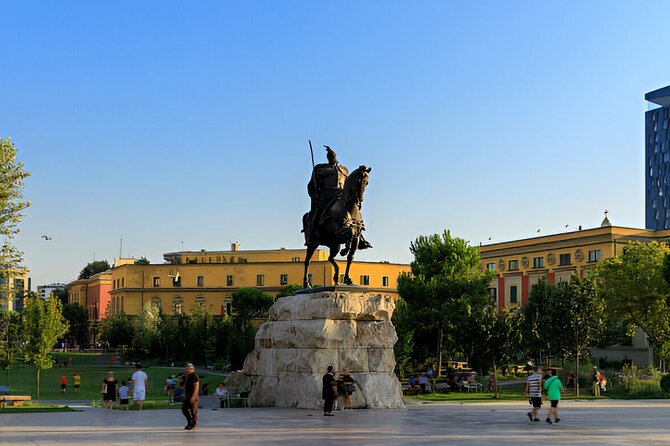
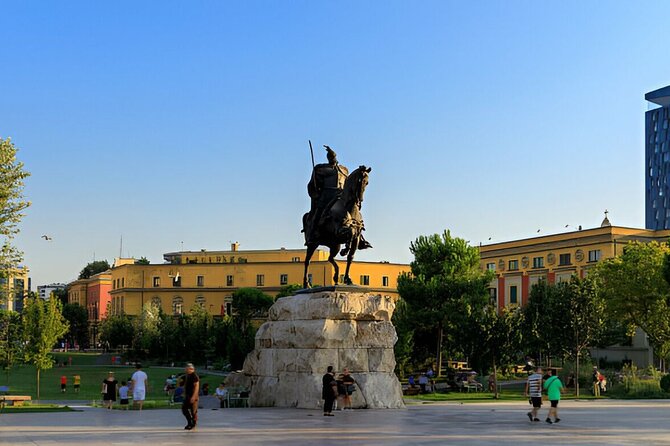
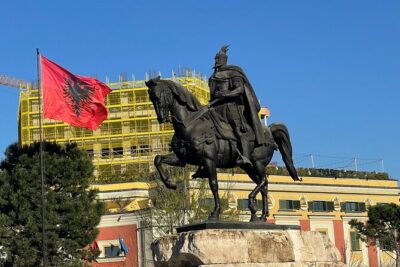
Skanderbeg Square is where Tirana becomes easy to understand. You’ll stand at the city’s main plaza named for Gjergj Kastrioti, known as Skanderbeg, and you’ll immediately notice the contrast between politics, religion, and daily life that shows up across the route.
At the center is the Skanderbeg Statue. Around it are major landmarks like the Opera and Ballet Theater and the National Library, plus government buildings, all wrapped in neo-Renaissance style. This matters because it gives you a strong visual reference point for the rest of the tour. When the guide later points out how Tirana grew and changed, you have an anchor in your mind.
I also like that this is a quick win. The tour begins here around 9:00 AM to 5:00 PM opening hours, so it is a good start time for daylight photos and for fitting everything into the half-day window.
If you come in already tired, you will still get value because this segment sets the stage quickly. And if you’re an early-morning person, you get the square with less pressure than later in the day.
More of Tirana on foot, on two wheels and after dark
- Albanian Night Show: Traditional Music, Dance & Dinner in Tirana★ 5.0 · 431 reviews
- Cooking Classes and Traditional food tasting in Tirana★ 5.0 · 282 reviews
- Local food experience & walking tour of Tirana★ 5.0 · 192 reviews
- Tour a Piedi di Tirana★ 5.0 · 174 reviews
- Best of Local Food & City Tour of Tirana – Food & Drinks Included★ 5.0 · 160 reviews
The Tirana Clock Tower climb for real city views
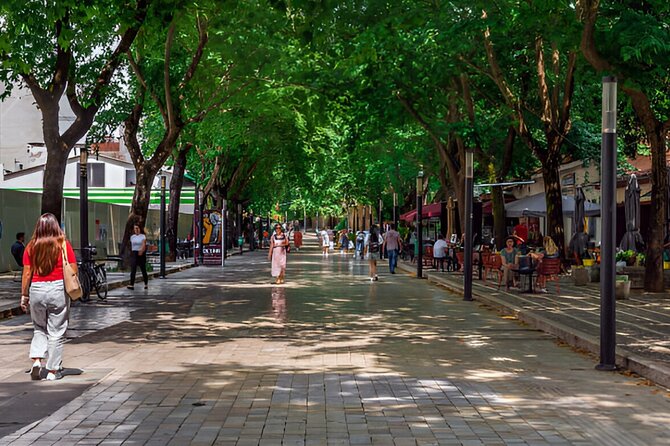
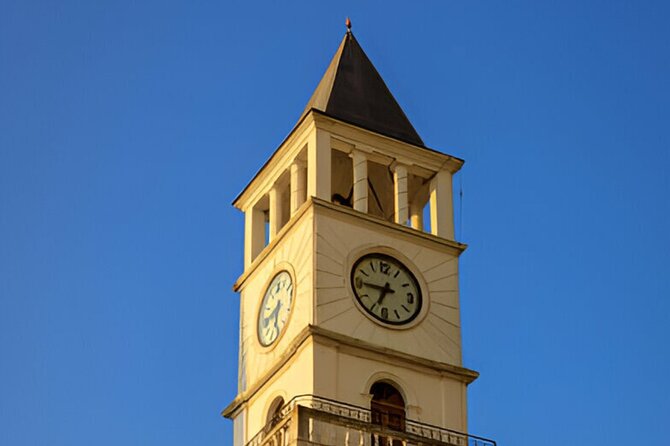
After you establish the center, the tour moves you toward elevation with the Tirana Clock Tower. The point is simple: step up, look out, and connect streets to landmarks.
From the tower area, you get panoramic views over Tirana’s lively layout. That matters more than it sounds, because it helps you understand distances and direction while you’re walking later toward neighborhoods and the riverfront.
Also, if you like photos, this is one of the easiest ways to get a wide-angle view without needing your own transportation. Even if you aren’t obsessed with city skylines, it gives context to the rest of the sites, especially the communist-era structures along the riverfront.
Wear comfortable shoes. You don’t need to train for a mountain, but you do want to be ready for quick walking segments throughout a 4-hour tour.
House of Leaves: the communist surveillance story in one powerful building
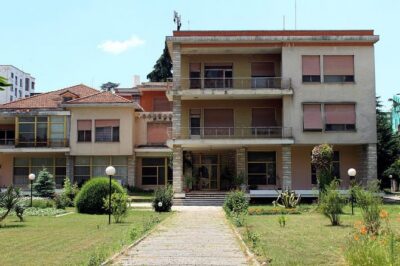
This is the stop that I think most people remember, and for good reason. The House of Leaves is a former headquarters of Albania’s secret police, now a museum that focuses on surveillance and what that system did to ordinary people.
You’re not just watching history from a distance. You’re in the space where the state’s machinery operated. That turns the story from abstract to specific. In places like this, the architecture and layout help you understand why people lived with fear, even when nothing was happening in public.
The tour typically gives you about an hour here, and that time is important. This kind of museum rewards your attention, especially if your mind keeps asking practical questions like Who watched? How did control work? What did resistance look like?
The best part is that you don’t have to be an Albania expert. The guide ties the setting to what you’re seeing in the exhibits. And since Tirana has other communist-era sites, this stop works as a foundation. It helps the later monuments make more sense, not less.
Practical tip: go in with a little emotional readiness. This museum is serious.
Sali Shijaku Villa: art you can almost hear
Next comes a very different tone. The House of Sali Shijaku is a traditional villa around 300 years old, tied directly to the painter Sali Shijaku, who worked and lived there. You’re basically stepping into a personal art environment, not a sterile gallery box.
Admission is included, and you get about 30 minutes. That’s not long, but it’s enough to take in what matters most: the vibe, the artworks, and the way an artist shaped the space.
One thing that stuck with me from the descriptions is an allegorical painting showing two roosters confronting each other. The scene sounds energetic and full of color, and it fits the idea that Shijaku’s work isn’t just decoration. It is full of symbolism and personality.
This stop also balances the heavier House of Leaves site. After the secret police museum, you want something human and creative. Shijaku’s villa gives you a pause, without ignoring the fact that Albania’s 20th century shaped artists as much as it shaped politics.
If you love art history but hate long museum marathons, this is a sweet length.
Pazari i Ri: market life in a renovated neighborhood
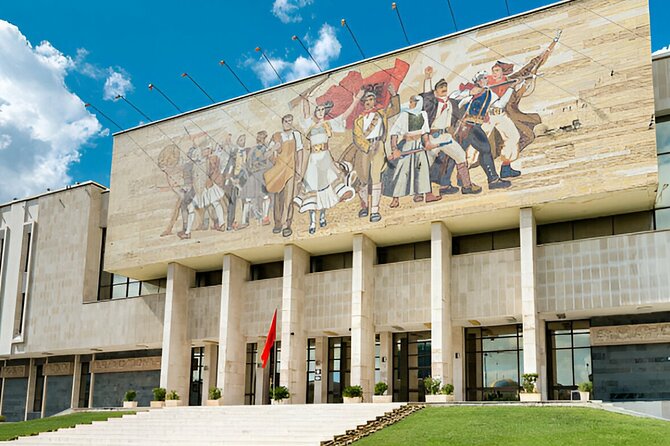
After the art, you get back to streets and daily routines at Pazari i Ri, also called the New Bazaar. This is one of the tour’s best choices for understanding how modern Tirana feels, not only how it remembers.
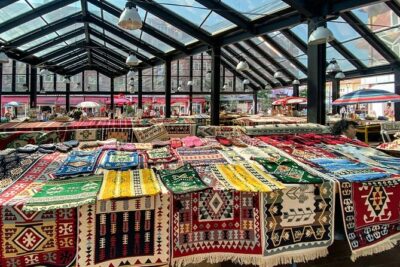
The neighborhood has had renovation and re-invigoration, but it kept many traditional elements of the old town. The central focus is the farmer marketplace, where more than 300 farmers from surrounding areas come to sell fresh fruit, vegetables, meat, seafood, and spices.
What makes this stop more than a quick glance is that the farmers tend to help you find good items and often share local history. You can learn by listening, even if you don’t buy much.
It is also free to enter, and the time on this stop is about 30 minutes. That’s just long enough to take in the energy, grab a snack if you want, and keep the flow going for the rest of the route.
This is a great moment if you like texture. You see color, smell, and local habits. It is also a useful reset after indoor museum time.
Other bunker and dictatorship-era tours in Albania

Tanners’ Bridge and the Ottoman-era hint in modern streets
Then the tour adds a small, quick landmark with Tanners’ Bridge. It is a picturesque stone bridge built in the 1700s during Ottoman rule.
Here’s the interesting detail: the bridge’s placement looks a little odd among modern city streets. That mismatch is exactly why it’s worth seeing. You get a sense of how Tirana changed over time, and how older structures can end up squeezed into new urban planning.
This stop is short, about 10 minutes, and admission is included. I’d describe it as a breather stop, a brief visual clue that gives you perspective.
If you like urban history, you’ll appreciate it more than if you only care about large monuments. But even then, it’s an easy win because it doesn’t drain your energy.
From Namazgah Mosque construction to Saint Paul Cathedral’s modern statement
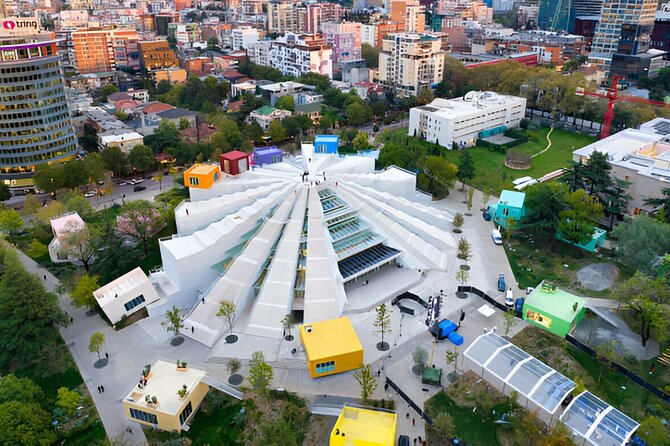
Tirana’s religious architecture shows up in a two-part contrast here.
First is the Great Mosque of Tirana, also called Namazgah Mosque. Right now it is being built, and the tour specifically notes that when completed it will become the largest mosque in the Balkans. This stop is about viewing the current construction context, not touring an interior.
Then you shift to Saint Paul Cathedral. This Catholic cathedral is relatively new, but it is immediately recognizable thanks to its unique architectural style. The tour frames it as a reference point for the Catholic population of the capital, and it draws both local believers and visitors.
I like this pairing because it forces you to see Tirana’s current identity and its layers. Construction signals future ambition. A new cathedral signals community life today. Together, they show religion as something active in the city, not just something frozen in the past.
Plan for photo time, but also keep your pace. You still have a string of outdoor and memorial stops ahead.
Pyramid of Tirana: Enver Hoxha’s monument and what comes next
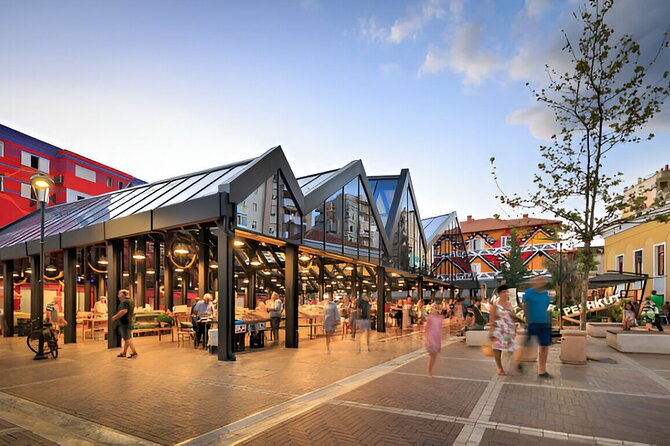
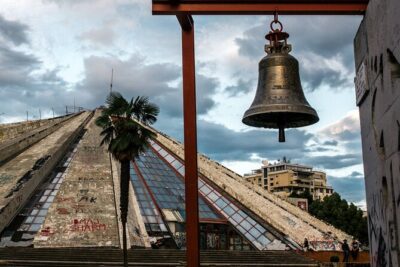
From the cathedral, the tour follows the riverfront to the Pyramid of Tirana, one of the communist-era relics people recognize right away. The tour explains that it was built as a museum dedicated to dictator Enver Hoxha before communism fell.
After that, the building served different roles over time, including a period as a NATO base during the Kosovo War. Today, work is being done to convert it into a youth cultural center.
So the Pyramid isn’t just a static history lesson. It’s a symbol of how Tirana reuses, repurposes, and rethinks its own structures. You’re seeing a city that can’t change the past, but tries to change what the past means in the present.
This stop is about 15 minutes, and admission is included. It is enough time to understand the story points and take photos from the outside.
If you’re the kind of traveler who likes to argue with your own assumptions about monuments, this is a good place to do it. A building like this makes you ask why governments build statements in concrete, and why later generations decide what to do with them.
Postbllok Checkpoint Monument: the prison connection in concrete
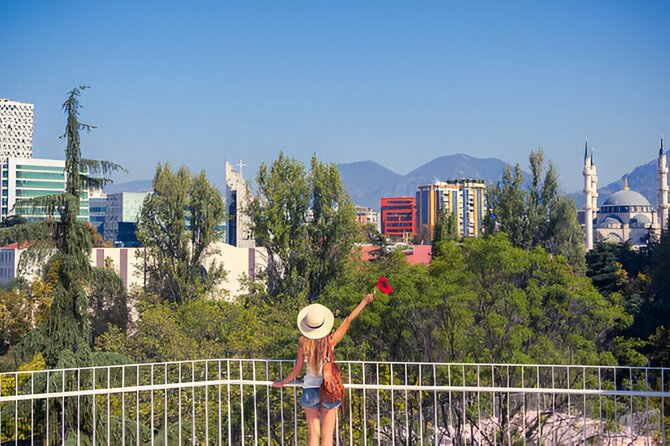
Next comes the Postbllok Memorial, also tied to Albania’s recent political history. The memorial includes three pieces, and one of them is especially direct: concrete girders taken from Spaç Prison, where Lubonja was imprisoned for a time.
The guide’s framing matters here. Seeing prison materials turned into public memory helps you understand how the past becomes a visible part of the city. It’s not just a plaque. It’s a physical reminder.
This stop is around 20 minutes with admission included. That length gives you time to read the details and to let the connection settle. If you go quickly, you miss what makes memorials hit hard: the specific names, the specific links, and the specific objects.
I also recommend being mentally present. This is one of those spots where scrolling your phone through photos can steal the meaning from the experience.
FAB Art Gallery at Mother Teresa Square: street energy meets student art
After memorial weight, the tour shifts to something lighter, but still interesting. The FAB Gallery is part of the University of Arts in Tirana, located at Mother Teresa Square.
This stop is about art production and support. The gallery mostly exhibits and promotes students of the Arts Academy and young artists. Most weeks focus on painting or photo exhibitions, but sometimes you’ll also catch short movie events.
Entry is generally free most of the time, and admission is included on the tour. Inside, the walls have colorful abstract graffiti, which keeps the gallery from feeling too precious.
The stop is about 30 minutes, and it is a nice way to finish the mental shift. After you’ve seen how the state monitored people, and how the country remembers prison and dictatorship symbols, you get to see creativity happening now, supported by institutions and public space.
If you enjoy contemporary art or you like seeing what younger artists are making, you’ll leave thinking about Tirana as a working art city, not only a museum city.
Where the New Bazaar and riverfront fit into the story
Taken as a whole, the route has a pattern. You start with the political center and urban layout. You then go into state power and surveillance with House of Leaves. After that, you pivot to individual art and market life, so you can see people and culture beyond institutions.
Then the riverfront and memorials bring back the political thread, with the Pyramid and Postbllok Memorial. Finally, FAB Gallery adds a present-day cultural note.
That arc is why the tour feels more than a list of stops. It gives you a way to interpret Tirana.
You’ll also get back to the meeting point at the end, which is convenient if you want to continue exploring on your own afterward, grab dinner, or head to a different neighborhood without guessing transportation.
Price and timing: why $58.18 feels fair for this mix
At $58.18 per person for a 4-hour tour, you’re paying for a lot of guided context plus included admissions at multiple stops. Some key sights are free to enter on their own, like Skanderbeg Square and Pazari i Ri, but several of the most time-intensive parts have admission included, including House of Leaves and the art and cathedral stops.
For me, the value comes from three things.
First, the mix is rare in a half-day. You get major monuments, museums, and a market moment without the tour stretching into a full day.
Second, group size is capped at 10 travelers. In a city like Tirana, that small number matters for photo timing and for hearing the guide clearly as you move.
Third, the tour uses a mobile ticket. No fuss.
The duration is about 4 hours, and the tour runs within a 9:00 AM to 5:00 PM window. So if you’re choosing your day, pick a time that gives you breathing room after. You’ll enjoy the experience more if you are not rushing into another obligation immediately after.
Average booking is about 14 days in advance, which is another sign this route fills up. If Tirana is a tight schedule for you, book earlier rather than later.
Small-group touring with Gjuljana: what the human part feels like
The tour includes guided commentary throughout, and the review detail that stands out is Gjuljana’s approach. She’s described as passionate and friendly, with real knowledge that stays grounded in what you’re looking at.
That matters because Tirana’s history can feel overwhelming if you only read signs. A good guide helps you connect the architecture, the monuments, and the museum exhibits into one storyline. It also helps when some sites are affected by closures or changes. A smaller group makes it easier for the guide to adjust without leaving you stranded.
With up to 10 travelers, you’ll usually get a bit more flexibility for photos and questions. And since the meeting point is Skanderbeg Square, it’s easy to regroup in the center if you need a quick break.
Who this Tirana tour suits best
I think this is a strong choice if you want a structured introduction to Tirana. It’s especially good for first-time visitors who want a mix of politics, art, architecture, and everyday life.
You’ll probably enjoy it most if you are curious about how Albania’s communist era still shapes the cityscape, but you don’t want to spend the whole day only in museums. The route purposely includes lighter cultural stops like the Sali Shijaku villa, the market atmosphere at Pazari i Ri, and the FAB Gallery.
If you prefer to wander endlessly without planned stops, you might find the schedule a bit full for your taste. And if you have mobility concerns, keep in mind the tour says it is not recommended for people over 95. It is for most travelers, but it is still a walking city tour.
Should you book this cultural tour?
Book it if you want a focused way to understand Tirana beyond the postcard view. This tour gives you the city center, museum depth at House of Leaves, art through Sali Shijaku, and the communist-era symbols that define the riverfront memory. The included admissions also help keep the budget predictable.
Skip it, or plan differently, if you hate walking and short stops. At 4 hours, you will see a lot, but you won’t linger like you would on a self-guided day. Also, if you’re visiting when certain sites are closed, you may not get every planned interior experience.
If you like context, small groups, and a route that connects history to what you can actually see, this is a smart way to spend your half-day.
FAQ
How long is the Tirana cultural tour?
It lasts about 4 hours.
How much does the tour cost?
The price is $58.18 per person.
Is it a small group tour?
Yes. It has a maximum of 10 travelers.
What kind of ticket do I get?
You get a mobile ticket.
Where does the tour start and end?
It starts at Skanderbeg Square in Tirana and ends back at the same meeting point.
Can I cancel for a full refund?
Yes. Free cancellation is available up to 24 hours in advance for a full refund.
Bunkers and the Dictatorship Years
Still in Tirana? Keep Going


Every Albania Review We Have

Latest Albania reviews off the desk
- UNESCO heritage in Albania – 4 days
★ 5.0 · 3 reviews - Transfers Tirana Airport – Sarande – Ksamil – Airport Tirana
★ 4.5 · 3 reviews - Private Transfers from Tirana International Airport to Sarandë
★ 4.5 · 3 reviews - Tirana’s Communist Past: A Tasting Tour with Traditional Lunch
★ 5.0 · 3 reviews - Tirana ⇔ Ohrid, North Macedonia
★ 5.0 · 3 reviews - Tirana and Kruja in a Day Trip
★ 5.0 · 3 reviews
Tirana City Tours & Experiences, compared.
 ★ 5.0Walking Tour of TiranaFrom $18646 reviews
 ★ 5.0Albanian Night Show: Traditional Music, Dance & Dinner in TiranaFrom $53431 reviews
 ★ 5.0Cooking Classes and Traditional food tasting in TiranaFrom $49282 reviews
 ★ 5.0Local food experience & walking tour of TiranaFrom $60192 reviews
 ★ 5.0Tour a Piedi di TiranaFrom $20174 reviews
 ★ 5.0Best of Local Food & City Tour of Tirana – Food & Drinks IncludedFrom $72160 reviews
 ★ 5.0Traditional Albanian Cooking Class in Tirana with Raki TastingFrom $53125 reviews
 ★ 5.0Bike or E-Bike Tour Tirana: Highlights & Grand Park Guided CycleFrom $42124 reviews
Browse the lists this tour appears in